
Best AI Courses for Customer Support Teams
AI is transforming customer support from reactive ticket handling to proactive, personalized service delivery. Support teams that understand AI can resolve issues faster, handle higher volumes without sacrificing quality, and focus human attention on complex problems that truly need it. These courses will help you master AI-powered support tools, learn how to design effective chatbot workflows, and develop the skills to combine AI automation with exceptional human service for the best customer experience.
Key AI Skills for Customer Support Teams
- Use AI chatbots and assistants for first-line support
- Write effective prompts for customer inquiry resolution
- Design AI-powered knowledge bases and self-service systems
- Analyze customer sentiment and satisfaction with AI tools
- Escalate and triage support tickets with AI assistance
- Train and improve AI support systems over time
How to Start Learning AI as a Customer Support Team
Start with a prompt engineering course to learn how to use LLMs for drafting responses, summarizing customer issues, and creating knowledge base articles (estimated 10-15 hours).
Take a generative AI fundamentals course to understand how AI chatbots work, their limitations, and best practices for deploying them in customer-facing roles (estimated 8-12 hours).
Practice building AI-assisted support workflows, testing different approaches for common ticket types and measuring their impact on resolution time and customer satisfaction (ongoing).
Recommended Courses for Customer Support Teams
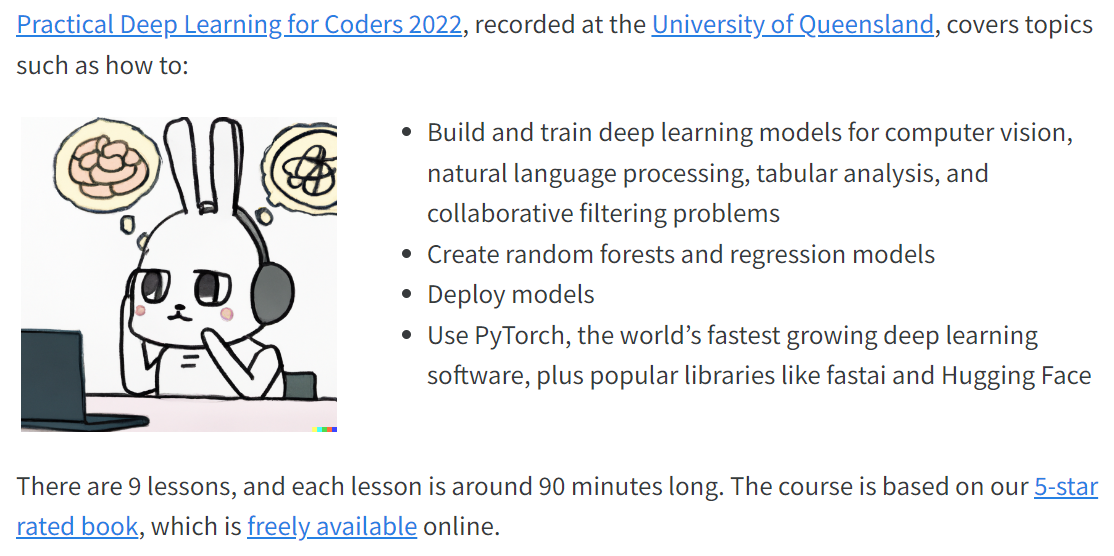
Practical Deep Learning for Coders
fast.ai

Introduction to Deep Learning
MIT

Machine Learning Crash Course

CS50's Introduction to Artificial Intelligence with Python
Harvard / edX

Intro to Machine Learning
Kaggle
Intro to Deep Learning
Kaggle

Intro to Machine Learning with PyTorch
Udacity
ChatGPT Prompt Engineering for Developers
DeepLearning.AI
Machine Learning Specialization
Coursera

Azure AI Fundamentals
Microsoft Learn

Elements of AI
University of Helsinki

AI For Everyone
Coursera

Google Data Analytics Professional Certificate
Coursera

IBM Applied AI Professional Certificate
Coursera

AI Foundations for Everyone Specialization
Coursera

Mathematics for Machine Learning and Data Science Specialization
Coursera

Python Basics for Data Science
edX
Deep Learning Fundamentals with Keras
edX

Machine Learning A-Z: AI, Python & R
Udemy

Python for Data Science and Machine Learning Bootcamp
Udemy

Stable Diffusion: Complete Guide to AI Image Generation
Udemy
The Complete ChatGPT Guide: Learn Midjourney, ChatGPT & More
Udemy

Complete Machine Learning & Data Science Bootcamp 2024
Udemy
Pair Programming with a Large Language Model
DeepLearning.AI

Introduction to Generative AI Learning Path
Google Cloud

Intro to TensorFlow for Deep Learning

Google Data Analytics Certificate
Google AI Essentials

Google's Python Class
Pandas
Kaggle
Data Visualization
Kaggle
Intro to AI Ethics
Kaggle
Machine Learning for Beginners
Microsoft
AI for Beginners
Microsoft
Generative AI for Beginners
Microsoft
IBM AI Developer Professional Certificate
Coursera

Machine Learning with Python
Coursera

Introduction to Deep Learning & Neural Networks with Keras
Coursera

AI Programming with Python Nanodegree
Udacity

Supervised Learning with scikit-learn
DataCamp
Data Scientist with Python Career Track
DataCamp
Working with the OpenAI API
DataCamp

Artificial Intelligence Foundations: Machine Learning
LinkedIn Learning
Machine Learning with Python: Foundations
LinkedIn Learning
Introduction to Generative AI
LinkedIn Learning
Deep Learning: Getting Started
LinkedIn Learning

Prompt Engineering Specialization
Coursera
Open Source Models with Hugging Face
DeepLearning.AI

Google Cloud: Introduction to AI and Machine Learning
edX
Intro to SQL
Kaggle
Prompt Engineering: How to Talk to the AIs
LinkedIn Learning
Python for Data Analysis with Pandas
LinkedIn Learning
Ethics in the Age of Generative AI
LinkedIn Learning

IBM Data Science Professional Certificate
Coursera

Generative AI: Introduction and Applications
Coursera

Generative AI: Prompt Engineering Basics
Coursera
Generative AI Concepts
DataCamp

Responsible AI Principles and Practices
Microsoft Learn
Microsoft Copilot Foundations
Microsoft Learn

How Google Does Machine Learning
Coursera

Introduction to TensorFlow for AI, ML, and DL
Coursera

The Data Science Course: Complete Data Science Bootcamp
Udemy
Data Science Essentials
edX
Prompt Engineering with Llama 2 & 3
DeepLearning.AI
Artificial Intelligence for Business Leaders
LinkedIn Learning
OpenCV Python For Beginners
Udemy

Responsible AI: Applying AI Principles with Google Cloud
Google Cloud

AI Product Management Specialization
Coursera
Carbon Aware Computing for GenAI Developers
DeepLearning.AI
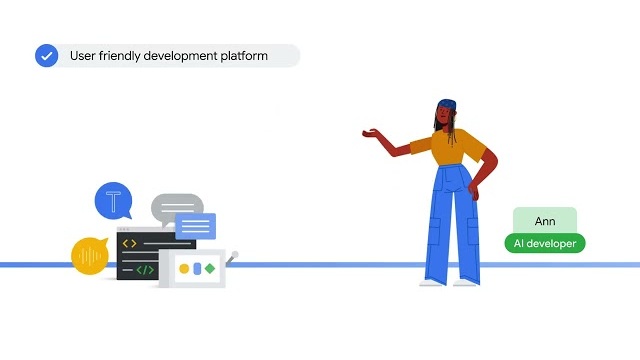
Introduction to Generative AI Studio
Google Cloud
OpenAI Python API Bootcamp: Build AI Apps Fast
Udemy
Understanding and Applying Text Embeddings
DeepLearning.AI

Ethics of AI
University of Helsinki
Data Cleaning
Kaggle
Intro to Programming
Kaggle

Azure OpenAI Service Fundamentals
Microsoft Learn
TensorFlow: Essential Training
LinkedIn Learning
Introduction to Statistics in Python
DataCamp
Building AI Applications with Watson APIs
Coursera
AI Ethics
Coursera
Introduction to Gemini API
Google Cloud
AWS Machine Learning Foundations
Udacity
AI Fluency: Framework & Foundations
Anthropic
Anthropic's Prompt Engineering Interactive Tutorial
Anthropic
LLM University (LLMU)
Cohere
Artificial Intelligence Fundamentals
IBM SkillsBuild
AI Foundations (OpenAI Academy)
OpenAI
Frequently Asked Questions
Will AI replace customer support agents?
AI handles routine inquiries and frees agents to focus on complex, high-value interactions. The best customer support combines AI efficiency for simple issues with human empathy and problem-solving for challenging situations.
How can support teams start using AI today?
Begin by using LLMs to draft responses to common questions, summarize long ticket threads, and search your knowledge base. Then gradually introduce AI-powered chatbots for first-line triage while monitoring quality closely.
How do I ensure AI support quality?
Implement human review of AI responses, monitor customer satisfaction scores, regularly update AI training data, set clear escalation rules, and continuously refine prompts and workflows based on feedback.