
Best AI Courses for Data Analysts
Data analysts are uniquely positioned to leverage AI and machine learning because you already work with data every day. Moving from descriptive analytics to predictive and prescriptive analytics with ML techniques is a natural career progression that significantly increases your impact and earning potential. These courses will teach you how to build machine learning models for forecasting, classification, and clustering using tools you may already be familiar with, like Python and SQL. You will learn to use scikit-learn for traditional ML, understand when to apply different algorithms, and interpret model results in ways that drive business decisions. Whether you want to transition to a data science role or simply add ML capabilities to your analyst toolkit, these courses provide a practical, project-based path forward.
Key AI Skills for Data Analysts
- Build predictive models with scikit-learn
- Apply regression and classification to business problems
- Perform feature engineering and data preprocessing
- Evaluate and interpret model performance
- Communicate ML results to non-technical stakeholders
- Use clustering and segmentation for customer analytics
How to Start Learning AI as a Data Analyst
Start with Kaggle's Intro to Machine Learning to learn core ML concepts in a familiar, hands-on environment with real datasets.
Progress to a structured course like the Machine Learning Specialization to build deeper understanding of algorithms and model selection.
Apply your skills to a real business problem at work or in a personal project, documenting your approach and results for your portfolio.
Recommended Courses for Data Analysts

Machine Learning Crash Course

CS50's Introduction to Artificial Intelligence with Python
Harvard / edX

Deep Learning for Computer Vision
Stanford Online

Intro to Machine Learning
Kaggle
Machine Learning Specialization
Coursera

Elements of AI
University of Helsinki

Machine Learning Scientist with Python
DataCamp

AI For Everyone
Coursera

Google Advanced Data Analytics Professional Certificate
Coursera

IBM AI Engineering Professional Certificate
Coursera

Mathematics for Machine Learning and Data Science Specialization
Coursera

MicroMasters in Statistics and Data Science
edX

Machine Learning
edX
Artificial Intelligence
edX

Machine Learning with Python: from Linear Models to Deep Learning
edX
Principles of Machine Learning
edX

Data Science: Machine Learning
edX

Machine Learning A-Z: AI, Python & R
Udemy

Python for Data Science and Machine Learning Bootcamp
Udemy

NLP - Natural Language Processing with Transformers in Python
Udemy

TensorFlow Developer Certificate in 2024: Zero to Mastery
Udemy

Complete Machine Learning & Data Science Bootcamp 2024
Udemy
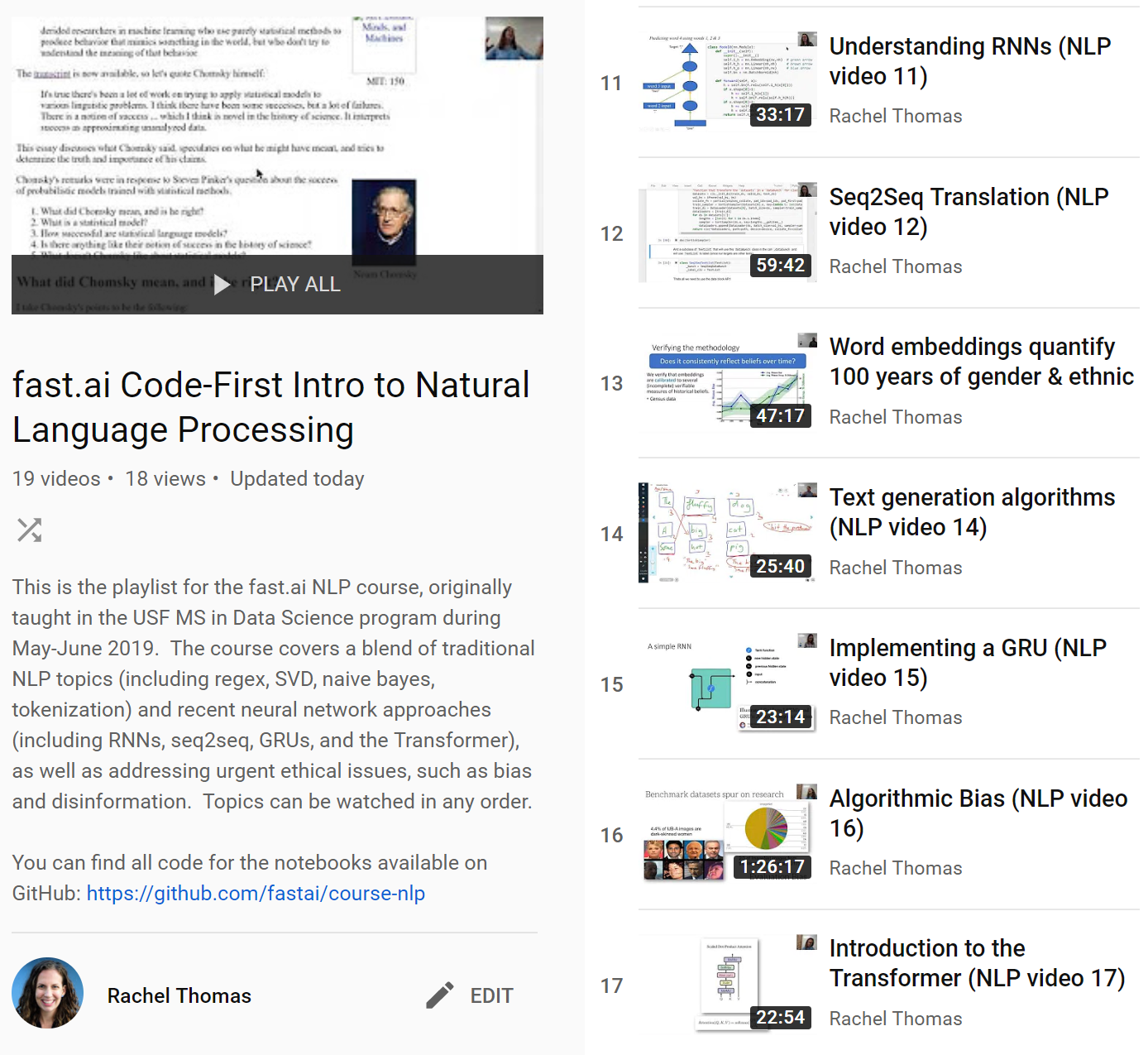
A Code-First Introduction to NLP
fast.ai

Introduction to Machine Learning
MIT OpenCourseWare
Artificial Intelligence
MIT OpenCourseWare

Machine Learning for Healthcare
MIT OpenCourseWare
Intermediate Machine Learning
Kaggle
Feature Engineering
Kaggle
Natural Language Processing
Kaggle
Computer Vision
Kaggle
Time Series
Kaggle
Machine Learning for Beginners
Microsoft

Azure Data Scientist Associate
Microsoft Learn

Machine Learning with Python
Coursera

AI Programming with Python Nanodegree
Udacity

Deep Learning in Python
DataCamp

Introduction to Natural Language Processing in Python
DataCamp
Supervised Learning with scikit-learn
DataCamp
Unsupervised Learning in Python
DataCamp
Data Scientist with Python Career Track
DataCamp

Artificial Intelligence Foundations: Machine Learning
LinkedIn Learning
Machine Learning with Python: Foundations
LinkedIn Learning
NLP with Python for Machine Learning Essential Training
LinkedIn Learning

Google Machine Learning Engineer Professional Certificate
Coursera

AWS Certified Machine Learning Specialty 2024
Udemy
Google Cloud: Introduction to AI and Machine Learning
edX
The Analytics Edge
edX

IBM Data Science Professional Certificate
Coursera

Data Scientist Nanodegree
Udacity

How Google Does Machine Learning
Coursera

Introduction to TensorFlow for AI, ML, and DL
Coursera

The Data Science Course: Complete Data Science Bootcamp
Udemy

Extreme Gradient Boosting with XGBoost
DataCamp

Professional Certificate in Data Science
edX
Computer Vision: Deep Learning with Python
LinkedIn Learning

AI for Medicine Specialization
Coursera

Modern Natural Language Processing in Python
Udemy
Machine Learning Fundamentals
edX

Introduction to Vertex AI
Google Cloud

Bayesian Machine Learning in Python: A/B Testing
Udemy

Feature Engineering for Machine Learning
Udemy
AWS Machine Learning Foundations
Udacity

Preprocessing for Machine Learning in Python
DataCamp

Deep Learning for Computer Vision with TensorFlow
Coursera
LLM University (LLMU)
Cohere
Artificial Intelligence Fundamentals
IBM SkillsBuild
Frequently Asked Questions
What is the difference between a data analyst and a data scientist?
Data analysts focus on describing what happened using data. Data scientists build predictive models and use advanced statistical methods. Learning ML bridges this gap and can help you transition from analyst to scientist.
Do I need to learn Python for ML?
Python is the dominant language for machine learning. If you currently use R or SQL, investing time in Python will open up the widest range of ML tools and courses. Many courses teach Python alongside ML concepts.
Which ML algorithms should data analysts learn first?
Start with linear regression, logistic regression, decision trees, and random forests. These algorithms are interpretable, widely used in business settings, and form the foundation for more complex models.
How can I apply ML in my current analyst role?
Look for prediction, classification, or segmentation problems in your daily work. Churn prediction, demand forecasting, customer segmentation, and anomaly detection are common high-impact use cases.