
Best AI Courses for Healthcare Professionals
Artificial intelligence is revolutionizing healthcare, from diagnostics and drug discovery to clinical decision support and personalized treatment plans. Physicians, nurses, and healthcare administrators who understand AI are better equipped to evaluate emerging tools, interpret AI-assisted diagnoses, and advocate for responsible adoption in clinical settings. Medical imaging analysis powered by deep learning is already matching specialist-level accuracy in radiology and pathology, and natural language processing is transforming how clinical notes are documented and analyzed. These courses will help you understand the AI technologies reshaping patient care, learn to critically evaluate AI diagnostic tools, and explore how machine learning models are trained on medical data. You do not need a computer science background — these courses bridge the gap between clinical expertise and AI literacy.
Key AI Skills for Healthcare Professionals
- Evaluate AI diagnostic tools for clinical accuracy and safety
- Understand medical image analysis with deep learning
- Interpret AI-driven clinical decision support systems
- Apply patient data analytics for treatment optimization
- Assess ethical implications of AI in healthcare settings
- Navigate regulatory requirements for AI medical devices
How to Start Learning AI as a Healthcare Professional
Start with AI for Medicine by deeplearning.ai or a similar healthcare-focused AI course to understand how machine learning applies to diagnostics, prognosis, and treatment (estimated 15-20 hours).
Take a computer vision fundamentals course to understand how AI analyzes medical images like X-rays, CT scans, and pathology slides (estimated 20-30 hours).
Explore AI ethics and data privacy courses to understand HIPAA compliance, algorithmic bias in clinical settings, and responsible AI deployment in healthcare (estimated 10-15 hours).
Recommended Courses for Healthcare Professionals
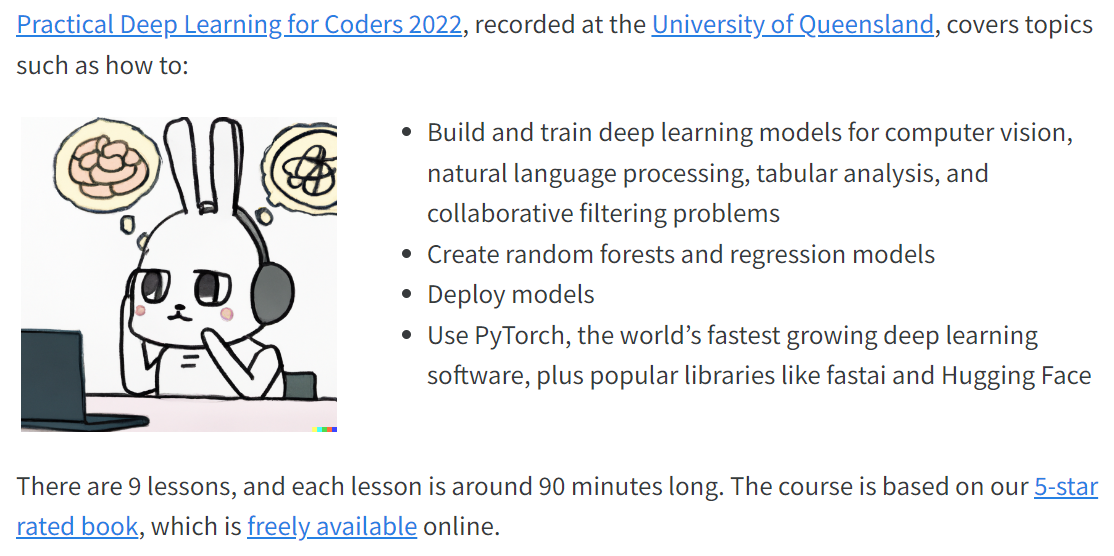
Practical Deep Learning for Coders
fast.ai

Introduction to Deep Learning
MIT

Machine Learning Crash Course

CS50's Introduction to Artificial Intelligence with Python
Harvard / edX

Deep Learning for Computer Vision
Stanford Online

Azure AI Fundamentals
Microsoft Learn

Elements of AI
University of Helsinki

AI For Everyone
Coursera

Google Advanced Data Analytics Professional Certificate
Coursera

IBM AI Engineering Professional Certificate
Coursera

Mathematics for Machine Learning and Data Science Specialization
Coursera

MicroMasters in Statistics and Data Science
edX

Machine Learning
edX

Artificial Intelligence
edX

Machine Learning with Python: from Linear Models to Deep Learning
edX

Python Basics for Data Science
edX
Principles of Machine Learning
edX

Data Science: Machine Learning
edX

Machine Learning A-Z: AI, Python & R
Udemy

Python for Data Science and Machine Learning Bootcamp
Udemy

TensorFlow Developer Certificate in 2024: Zero to Mastery
Udemy

Complete Machine Learning & Data Science Bootcamp 2024
Udemy

Deep Learning and Computer Vision A-Z: OpenCV, SSD & GANs
Udemy
Introduction to Machine Learning
MIT OpenCourseWare
Artificial Intelligence
MIT OpenCourseWare

Machine Learning for Healthcare
MIT OpenCourseWare

Intermediate Machine Learning
Kaggle
Feature Engineering
Kaggle
Computer Vision
Kaggle
Time Series
Kaggle
Intro to AI Ethics
Kaggle

Azure AI Engineer Associate
Microsoft Learn
Machine Learning for Beginners
Microsoft
AI for Beginners
Microsoft
Azure Data Scientist Associate
Microsoft Learn

IBM AI Developer Professional Certificate
Coursera

Machine Learning with Python
Coursera

Computer Vision Nanodegree
Udacity

Image Processing in Python
DataCamp

Data Scientist with Python Career Track
DataCamp

Artificial Intelligence Foundations: Machine Learning
LinkedIn Learning
Machine Learning with Python: Foundations
LinkedIn Learning
Introduction to Generative AI
LinkedIn Learning

Google Machine Learning Engineer Professional Certificate
Coursera

AWS Certified Machine Learning Specialty 2024
Udemy
Open Source Models with Hugging Face
DeepLearning.AI
Google Cloud: Introduction to AI and Machine Learning
edX
Ethics in the Age of Generative AI
LinkedIn Learning

IBM Data Science Professional Certificate
Coursera

Data Scientist Nanodegree
Udacity

Responsible AI Principles and Practices
Microsoft Learn
How Google Does Machine Learning
Coursera

The Data Science Course: Complete Data Science Bootcamp
Udemy
Data Science Essentials
edX

OpenCV Python For Beginners
Udemy
Responsible AI: Applying AI Principles with Google Cloud
Google Cloud

Extreme Gradient Boosting with XGBoost
DataCamp

Professional Certificate in Data Science
edX
Carbon Aware Computing for GenAI Developers
DeepLearning.AI
Computer Vision: Deep Learning with Python
LinkedIn Learning

AI for Medicine Specialization
Coursera

Ethics of AI
University of Helsinki
Machine Learning Fundamentals
edX

Introduction to Vertex AI
Google Cloud

Bayesian Machine Learning in Python: A/B Testing
Udemy
Introduction to Statistics in Python
DataCamp
Building AI Applications with Watson APIs
Coursera
AI Ethics
Coursera
Introduction to Computer Vision
edX

Feature Engineering for Machine Learning
Udemy
AWS Machine Learning Foundations
Udacity

Preprocessing for Machine Learning in Python
DataCamp

Deep Learning for Computer Vision with TensorFlow
Coursera
Probability - The Science of Uncertainty and Data
edX
Artificial Intelligence Fundamentals
IBM SkillsBuild
Frequently Asked Questions
Do doctors need to learn programming to use AI?
No. Most clinical AI tools have user-friendly interfaces designed for healthcare professionals. Understanding how AI works at a conceptual level is more important than coding. However, basic Python skills can help you evaluate research papers and prototype ideas.
How is AI currently used in clinical practice?
AI is used in radiology for image analysis, in pathology for slide screening, in clinical documentation through ambient listening tools, in drug interaction checking, and in predicting patient deterioration. Adoption is growing rapidly across specialties.
What are the biggest risks of AI in healthcare?
Key risks include algorithmic bias from non-representative training data, over-reliance on AI without clinical judgment, patient privacy concerns, and lack of transparency in how AI models reach conclusions. Understanding these risks is essential for responsible adoption.
How long does it take to become AI-literate as a healthcare professional?
A solid foundation can be built in 30-50 hours of focused study. Start with a healthcare-specific AI overview, then explore areas most relevant to your specialty. Ongoing learning is important as the field evolves rapidly.