
Best AI Courses for Legal Professionals
The legal profession is experiencing a significant AI transformation. From contract analysis and legal research to document review and compliance monitoring, AI tools are automating tasks that once consumed hundreds of billable hours. Large language models can now draft legal documents, summarize case law, and identify relevant precedents with remarkable speed. Legal professionals who understand these technologies can deliver better client outcomes, reduce costs, and focus their expertise on higher-value strategic work. These courses will help you understand how natural language processing powers legal AI tools, learn effective prompt engineering for legal research and drafting, and navigate the ethical considerations of using AI in legal practice. Whether you are a solo practitioner or part of a large firm, AI literacy is becoming as essential as legal research skills.
Key AI Skills for Legal Professionals
- Use AI tools for contract analysis and due diligence
- Automate legal research with LLM-powered platforms
- Apply prompt engineering for legal document drafting
- Evaluate AI compliance and regulatory monitoring tools
- Understand ethical obligations when using AI in legal practice
How to Start Learning AI as a Legal Professional
Begin with a prompt engineering course to learn how to effectively use LLMs for legal research, document summarization, and drafting tasks (estimated 10-15 hours).
Take an NLP fundamentals course to understand how AI processes and analyzes legal text, enabling you to better evaluate legal AI tools (estimated 15-20 hours).
Explore AI ethics and regulation courses to understand the evolving legal landscape around AI, professional responsibility considerations, and how to advise clients on AI governance (estimated 10-15 hours).
Recommended Courses for Legal Professionals
Practical Deep Learning for Coders
fast.ai

Introduction to Deep Learning
MIT

NLP Course
Hugging Face

Generative AI with Large Language Models
Coursera

Natural Language Processing with Deep Learning
Stanford Online
ChatGPT Prompt Engineering for Developers
DeepLearning.AI
LangChain for LLM Application Development
DeepLearning.AI

Azure AI Fundamentals
Microsoft Learn

Machine Learning Scientist with Python
DataCamp

Natural Language Processing Specialization
Coursera

TensorFlow Developer Professional Certificate
Coursera

NLP - Natural Language Processing with Transformers in Python
Udemy

LangChain Masterclass - Build 15 LLM Apps with LangChain
Udemy

The Complete ChatGPT Guide: Learn Midjourney, ChatGPT & More
Udemy

TensorFlow Developer Certificate in 2024: Zero to Mastery
Udemy
Generative AI, LLMs - OpenAI API, LangChain, Hugging Face
Udemy
Finetuning Large Language Models
DeepLearning.AI
LangChain: Chat with Your Data
DeepLearning.AI
AI Agents in LangGraph
DeepLearning.AI
Vector Databases: from Embeddings to Applications
DeepLearning.AI
Quality and Safety for LLM Applications
DeepLearning.AI
Building and Evaluating Advanced RAG Applications
DeepLearning.AI
Preprocessing Unstructured Data for LLM Applications
DeepLearning.AI
Pair Programming with a Large Language Model
DeepLearning.AI
Knowledge Graphs for RAG
DeepLearning.AI
Building Multimodal Search and RAG
DeepLearning.AI
Automated Testing for LLMOps
DeepLearning.AI
Build an LLM App with LangChain.js
DeepLearning.AI
Computational Linear Algebra
fast.ai
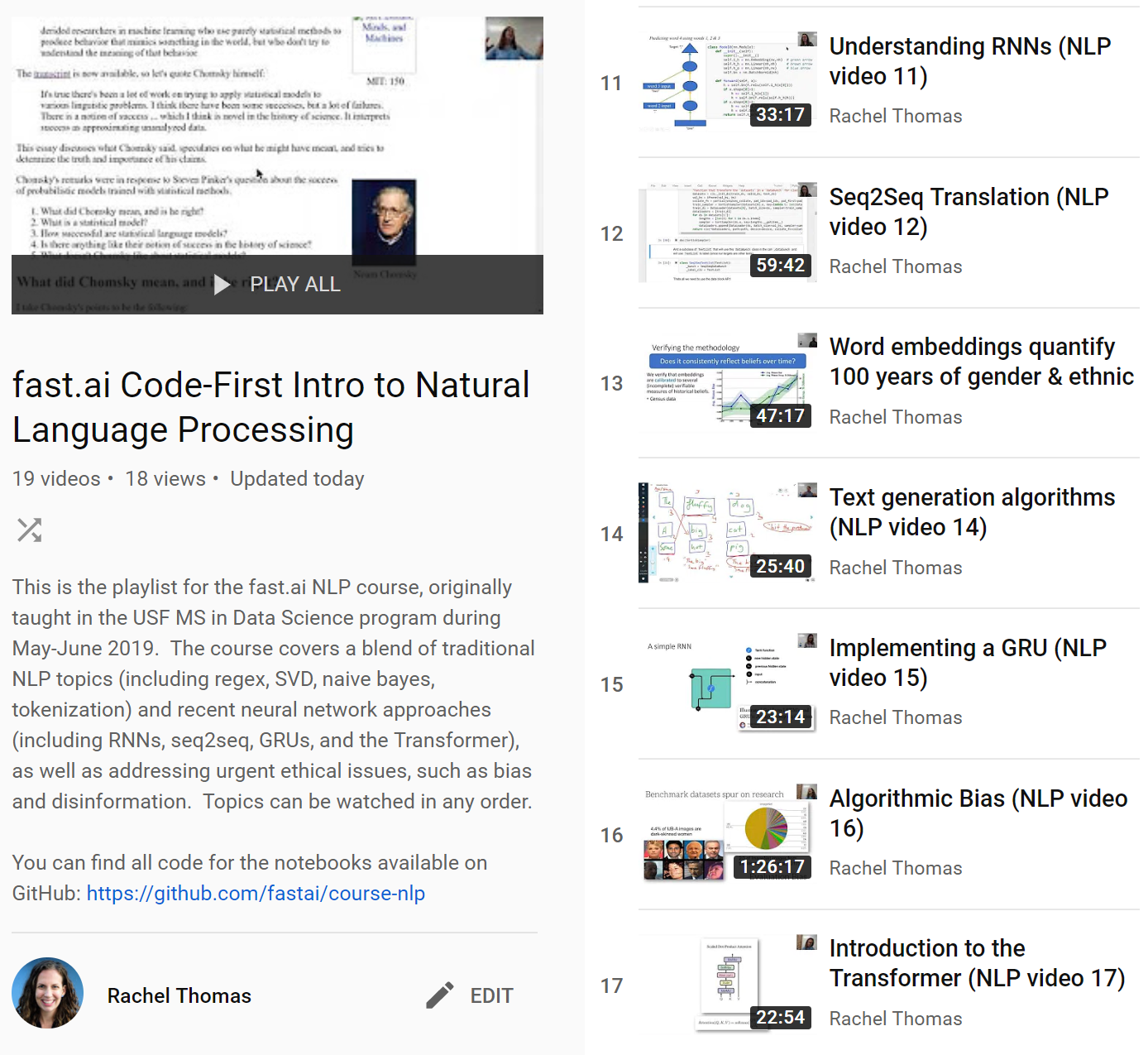
A Code-First Introduction to NLP
fast.ai

Machine Learning for Healthcare
MIT OpenCourseWare

Introduction to Generative AI Learning Path
Google Cloud

Intro to TensorFlow for Deep Learning

Google AI Essentials

Natural Language Processing
Kaggle
Intro to AI Ethics
Kaggle

Azure AI Engineer Associate
Microsoft Learn
AI for Beginners
Microsoft
Generative AI for Beginners
Microsoft

IBM AI Developer Professional Certificate
Coursera

Natural Language Processing Nanodegree
Udacity

Introduction to Natural Language Processing in Python
DataCamp
Working with the OpenAI API
DataCamp

NLP with Python for Machine Learning Essential Training
LinkedIn Learning
Introduction to Generative AI
LinkedIn Learning

Prompt Engineering Specialization
Coursera
AI Agents & RAG: Build 10 Real AI Agent Apps with LangChain
Udemy
Large Language Models with Semantic Search
DeepLearning.AI
Open Source Models with Hugging Face
DeepLearning.AI
Quantization Fundamentals with Hugging Face
DeepLearning.AI

Serverless LLM Apps with Amazon Bedrock
DeepLearning.AI

Building AI Agents with Hugging Face
Hugging Face
Prompt Engineering: How to Talk to the AIs
LinkedIn Learning
Ethics in the Age of Generative AI
LinkedIn Learning

Generative AI: Introduction and Applications
Coursera

Generative AI: Prompt Engineering Basics
Coursera
Generative AI Concepts
DataCamp

Responsible AI Principles and Practices
Microsoft Learn

Microsoft Copilot Foundations
Microsoft Learn
Prompt Engineering with Llama 2 & 3
DeepLearning.AI
Building Event-Driven Generative AI Applications
DeepLearning.AI

Generative AI Nanodegree
Udacity

Responsible AI: Applying AI Principles with Google Cloud
Google Cloud
Carbon Aware Computing for GenAI Developers
DeepLearning.AI

AI for Medicine Specialization
Coursera
Introduction to Generative AI Studio
Google Cloud

IBM Generative AI Engineering Professional Certificate
Coursera

Modern Natural Language Processing in Python
Udemy
Efficiently Serving LLMs
DeepLearning.AI
Multi AI Agent Systems with crewAI
DeepLearning.AI
Understanding and Applying Text Embeddings
DeepLearning.AI

Ethics of AI
University of Helsinki
Azure OpenAI Service Fundamentals
Microsoft Learn

Building AI Applications with Watson APIs
Coursera
AI Ethics
Coursera

Open-Source AI Cookbook
Hugging Face
LangChain Essential Training
LinkedIn Learning
LLMOps
DeepLearning.AI
Introduction to LLMs in Python
DataCamp
Building with the Claude API
Anthropic
AI Fluency: Framework & Foundations
Anthropic
Anthropic's Prompt Engineering Interactive Tutorial
Anthropic
LLM University (LLMU)
Cohere
Artificial Intelligence Fundamentals
IBM SkillsBuild
Agents and Workflows (OpenAI Academy)
OpenAI
AI Foundations (OpenAI Academy)
OpenAI
Applied AI Foundations (OpenAI Academy)
OpenAI
Frequently Asked Questions
Will AI replace lawyers?
AI is automating routine legal tasks like document review and research, but strategic counsel, courtroom advocacy, client relationships, and complex negotiations still require human judgment. Lawyers who use AI effectively will outperform those who do not.
What are the ethical considerations of using AI in law?
Key considerations include client confidentiality when using cloud AI tools, duty of competence in understanding AI limitations, accuracy verification of AI-generated legal research, and transparency with clients about AI usage in their matters.
Which AI tools are most useful for legal professionals?
Legal-specific AI platforms for contract analysis, research assistants powered by LLMs, document review tools for e-discovery, and compliance monitoring systems are among the most impactful. General tools like ChatGPT and Claude are also valuable for drafting and research.
How can small firms benefit from AI?
Small firms can use AI to compete with larger firms by automating research, streamlining document review, and improving client communication. Many AI legal tools offer affordable pricing tiers that make them accessible to practices of any size.